Regrowing Celery

How to Regrow Celery ~ from kitchen scraps

We have a small backyard garden and we love to grow our own food.  Growing celery seems too fussy until I found this post.  We always have a celery stalk in the fridge, and until now the base has been simply discarded to the chickens.  No longer!  Ready to learn how regrowing celery works?
Regrowing Celery ~ how to  grow food from kitchen scraps

Sustainable Food Scraps ~ gardening with kids

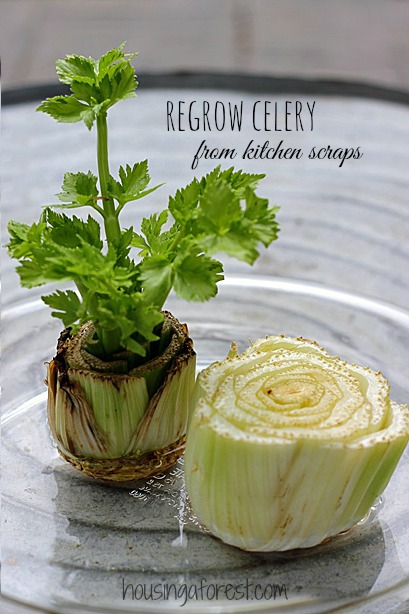
Simply chop the base from the celery stalk, leaving about 2 inches.  Place it in a dish of water in a sunny location.  Something that easy sounds too good to be true.  But that is all you need to do.

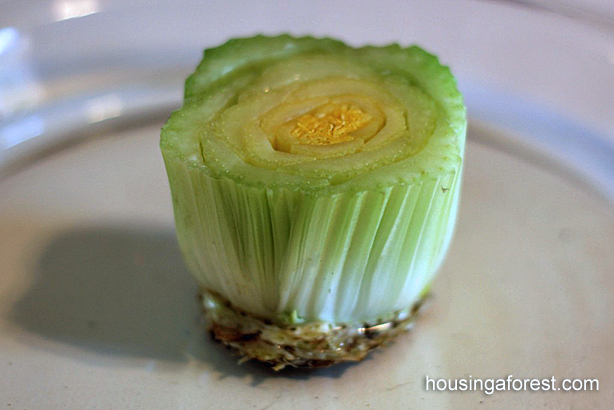
Notice how yellow the center leaves are.  That is the area that we will be watching for growth.
Regrowing Celery ~ how to  grow food from kitchen scraps

You will start noticing changes quickly.  After just a couple days in the water, you should see the celery’s center leaves starting to grow.  No roots will be visible yet.

After just 1 week, the center leaves should change color and starting to poke up a little bit.  Still no roots at this point.
Regrowing Celery ~ how to make a mini green house

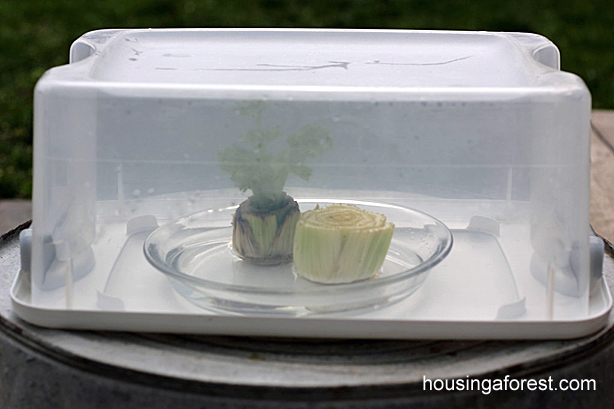
Make your own mini green house

Since our house does not have wonderful sunny windows for growing plants.  So we resorted to creating a mini green house, and taking the celery outside.  The weather is warming up, but it is still cool outside at nights.  The inverted plastic box helped to regulate the temperature and keep it moist.  Notice all the moisture on the side of the container.  This is also a great way to start seeds, but just make sure you are checking on your plants/seeds, so they don’t get too hot or dry out.
Regrowing Celery ~ how to  grow food from kitchen scraps

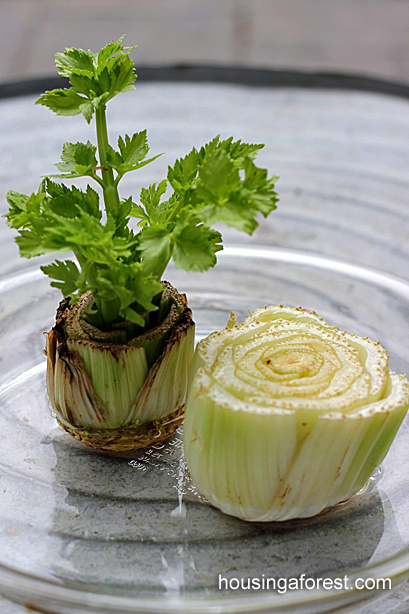
Our celery has been growing in only water for three weeks.  We are just getting aroung to transplanting it into soil.  This step could be done sooner.  I am amazed at how little attention our little celery plant needed.  Which is perfect for our house:)

Notice the difference between the 3 week old celery plant and the “new” celery base.  There is no growth on the new plant yet, but it will happen really quickly!
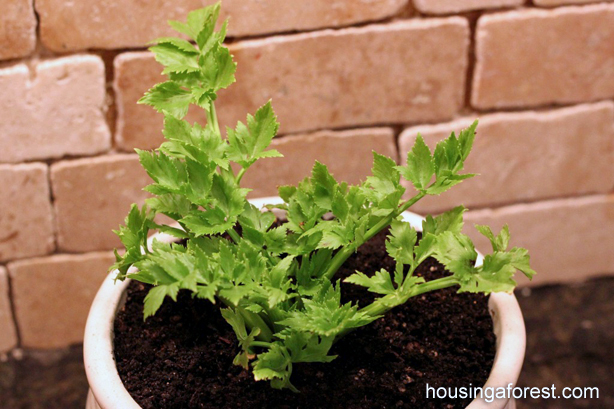
Regrowing Celery ~ how to  grow food from kitchen scraps

We finally transplanted our little celery and he is so happy!  I am curious how long it will take before our little celery plants are ready to be eaten.

Tips for growing Celery:

  • Celery does not grow well in hot conditions, so make sure you give your celery plant adequate water and shade during the hottest part of the day.  If your plant does not receive enough water, it will become tough and stringy.  YUCK!  So keep your plant hydrated!
  • You can remove only a few stalks of celery at a time.  No need to harvest the whole plant. When doing this, make sure you remove the outer stalks first and let the less developed inner stalks continue growing. Take care not to damage the rest of the plant if removing individual stalks.

The kids love snacking on celery, so we are really excited to see how it tastes!  They think it will be AMAZING to run out to the garden and “sneak” a celery stalk.  There is something about growing your own food that is really satisfying!

You also might want to try our simple tutorial on how to Regrow Lettuce.
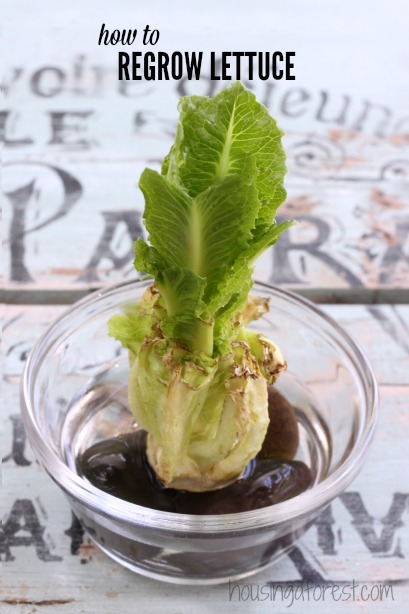
Regrow Lettuce ~ how to grow food from kitchen scraps

For more ways to encourage kids to garden, check out our:

Gourd Surprise

How to Grow Sprouts on a Sponge

27 DIY Garden Markers

Starting Seeds

Regrow Lettuce

A Cozy Flannel Quilt

Bree is well on her way to surpassing my sewing skills.  She really wants to learn to sew her own clothes.  Love that, but one step at a time.

Now that Bree has worked on her sewing basics, she was ready to move onto something more fun.  I found this EASY quilt tutorial through Pinterest and knew that it would be a fun project for her.  She wanted to sew something special for her new little cousin, and this was perfect!  This simple quilt uses only straight stitches, and once you are finished with the top, all that is left is the binding.  Love that!  Quick, easy and cute all in one.

Bree picked out a cute color scheme of “grizzly bear brown” (for her Uncle!) and coordinating girly flannels.

Check out this video for detailed instructions, but here is a quick overview of what we did.  The fabric you will need is…

(2) 1 yard cuts of flannel to make the top and back.  (Eventually cut into a 36″ square)

(5 different coordinating fabrics) 3 1/2″ x 45″ strips.  You will eventually cut each strip into 3 1/2″ squares.

(1) 1 yard of batting

Make sure to buy a bit of extra fabric for each cut, the fabric with shrink when washed.

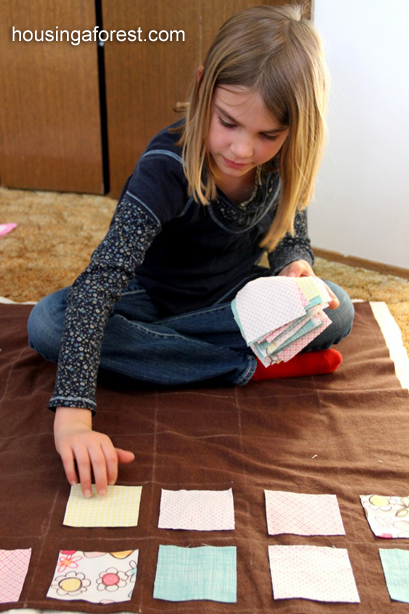
The grid is  4 1/2″ square, where we centered the cut fabric squares.  We used a piece of chalk to grid our lines.  It was fun to watch Bree lay out her quilt.  It was very important to her that it was not a perfect pattern, but also that no 2 alike squares were too close.  Love it!

Once the quilt was all planned out, we used a glue stick to secure the fabric temporarily.  I loved this step since there was no pins for Bree’s fingers to get pricked on.  They suggest to use a fabric glue stick, but we just used a washable paper glue stick and it worked perfectly.  We were careful to keep the glue in the center of each square so we didn’t have to worry about sewing over it.

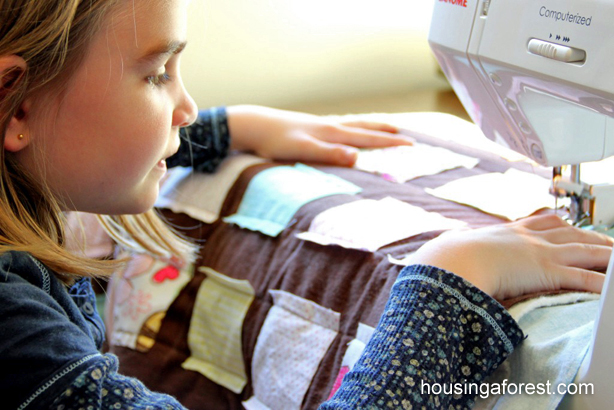
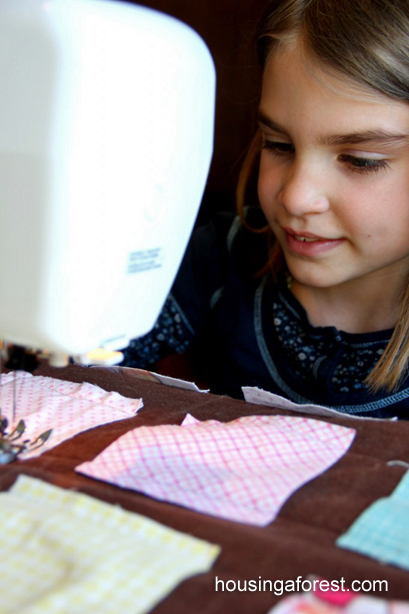
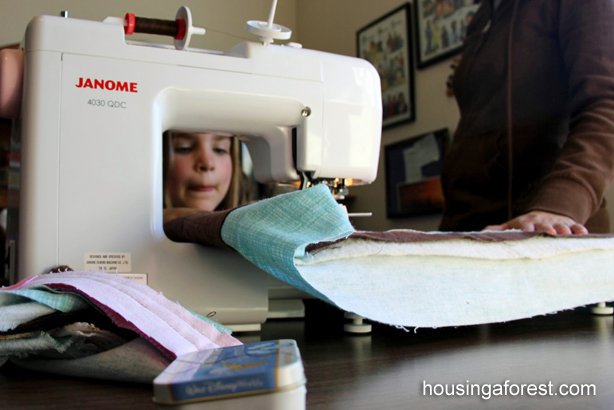
Next we sandwiched the top, batting and bottom.  Bree sewed straight lines down each side of a line of squares.  Then turned the fabric a quarter turn and sewed down the other sides of the square.  Notice my favorite feature of this sewing machine for teaching little ones…the speed adjustment.  We set it on a slow speed so that no matter how hard she pushed on the pressure foot, she could only go too fast.  No sudden speed bursts that can scare our beginner sewer.

I helped by holding the extra fabric.  It had a tendency to slip off the table and pull the quilt wonky.  Bree finished this quilt in an afternoon.  She was so determined to finish it and so proud that she was able to sew it all her self!  We added turquoise binding strips.  This is not necessary, but I love how it turned out.  This was the only part of the quilt that she needed help sewing.

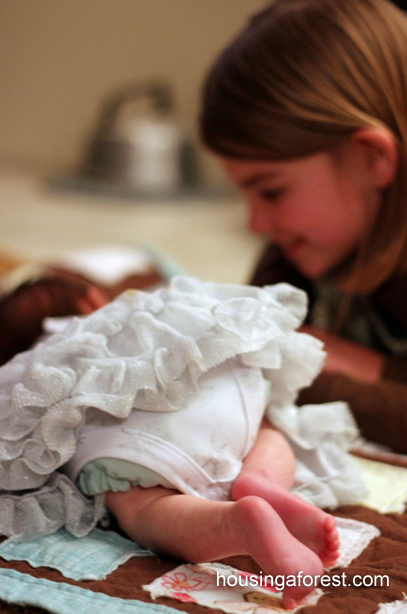
Bree could not wait to see what her baby cousin thought of it!  So sweet!  She also enjoyed showing it off to anyone that stopped by.

Once this quilt is washed a few times it should “fray up” and look similar to a rag quilt.  I’m sure that Bree will be asking to sew another quilt soon, only this time on a larger scale for her.  I am so proud of our little seamstress.  Great work Bree!